Symposium on Environmental Monitoring of Infectious Diseases
Together with Anna Székely, I have been working on the organization of a DDLS Symposium on Data-Driven Environmental Monitoring of Infectious Diseases on October 7 – 8, in Uppsala.
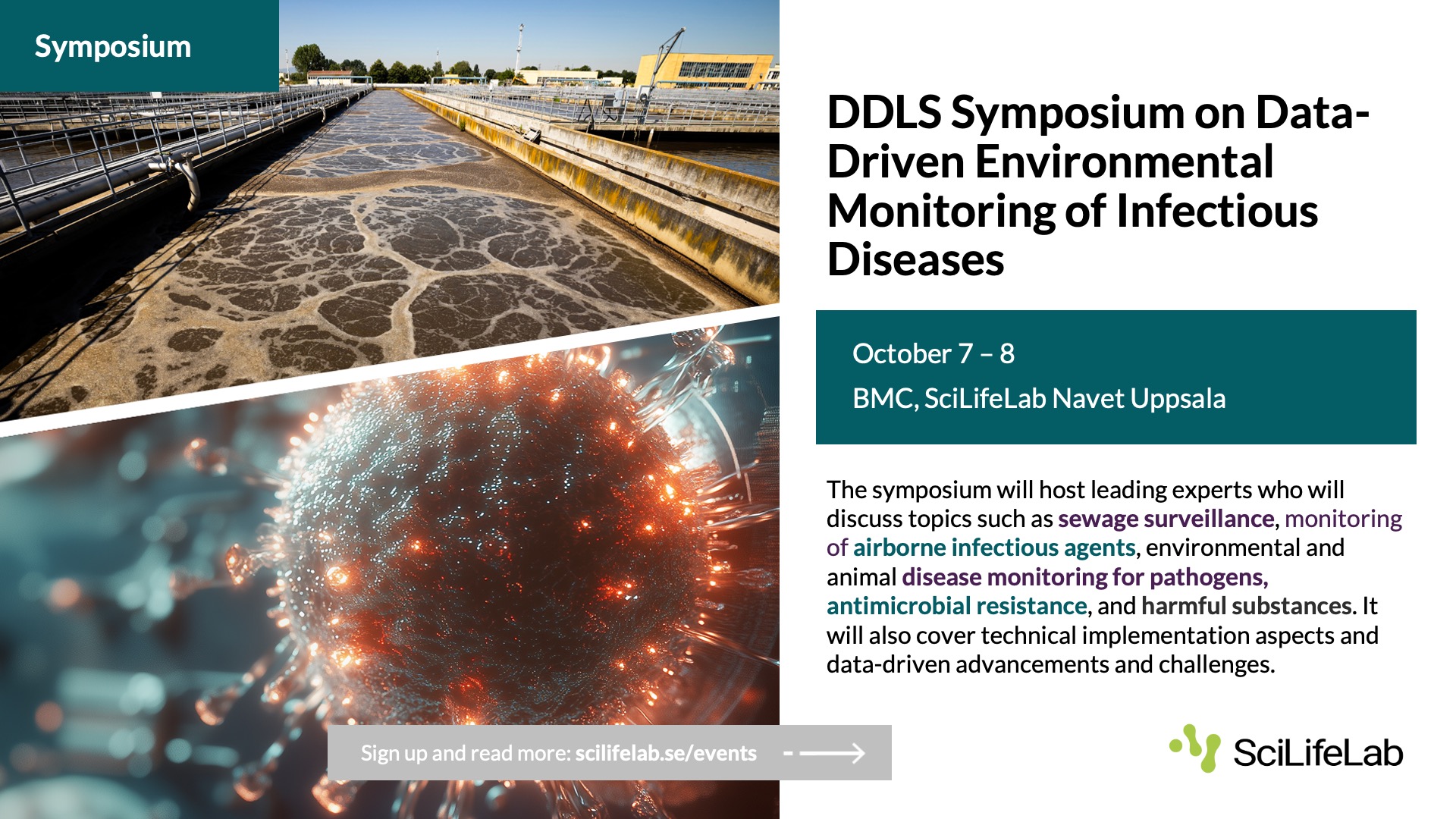
The symposium will focus on promoting and enhancing data-driven environmental assessment for infectious diseases (including antibiotic-resistant bacteria) across various settings using diverse approaches. We now invite submission of abstracts for short talks.
Deadline for abstract submission: 18 September
Deadline to register to attend: 25 September –> REGISTER HERE! <– This includes abstract submission.
Link to more information and the PROGRAM
I hope to see all of you working with AMR in the environment in Uppsala in October!
20 positions for data scientists
I thought this could be interesting to some. SciLifeLab has opened 20 permanent staff positions for the new Data platform and Data Science Nodes (DSNs) organised within the DDLS program (that also funds my current position). These can be exciting opportunities to work with big data for someone who might not want to climb the academic group leader career ladder. The positions are spread out over Stockholm, Uppsala, Gothenburg and Linköping and can be found here.
Welcome Vi and Marcus
I am very happy to share with you that our two doctoral students funded by the Wallenberg DDLS initiative have now started. One of them – Marcus Wenne – is already a well-known figure in the lab, as he has been with us as a master student and then as a bioinformatician for more than a year. The other student – Vi Varga – is a completely new face in the lab and just started yesterday.
Marcus will work in a project on global environmental AMR. He will also continue on his work on large-scale metagenomics to understand community dynamics and antibiotic resistance selection in microbial communities subjected to antibiotics selection. Marcus will work very closely to EMBARK and continue the important work we have done in that project over the next four years.
Vi will study responses of microbial communities to change, with a particular focus on comparative genomics and transcriptional approaches. We will link this to both community stability, pathogenesis and resistance to antibiotics, so this project involves a little bit of everything in terms of the lab’s research interests. Vi’s background is in comparative genomics and pathogenesis, so this seems to be the perfect mix to be able to carry out this project successfully!
Very welcome to the lab Marcus and Vi! We look forward to work with you for the next four years or so!
DDLS Talks
I will be giving talks on data driven life science – specifically on antibiotic resistance and pathogenicity – on two different events organised within the Data Driven Life Science program (DDLS) in the next month. First up is on the DDLS Annual Conference, coming up already next week (15-16 November). Here, I will give a talk on the evolution of pathogenicity, outlining some of our ongoing work towards finding novel virulence factors. There will also be talk from the other DDLS fellows, as well as Samuli Ripatti and Cecilia Clementi.
On-site registration closes on November 9 so make sure to grab one of the last spots at this exciting event! Register here – online attendance is also possible for those who don’t want to travel to Stockholm.
Then in December, I will be talking at the Data-driven Epidemiology and biology of infections Research Area Symposium in Gothenburg on how to predict the disease threats of the future. This symposium takes place in Gothenburg on December 7 to 8, but again online participation is also possible. Aside from me, Nicholas Croucher will talk about genomic surveillance data and bacterial epidemiology, Bill Hanage will talk about decisions in an imperfect world and Tove Fall will talk about dynamic disease surveillance. There will also be talks about the new DDLS fellows in epidemiology and infection biology, which is what I am perhaps most excited about: Thomas van Boeckel, Luisa Hugerth and Laura Carroll! It seems like registration has not yet opened for this event, but keep monitoring this site.
I look forward to see you at these events!
We’re hiring 2 PhD students and a postdoc
As I wrote a few days ago, I have now started my new position at Chalmers SysBio. This position is funded by the SciLifeLab and Wallenberg National Program for Data-Driven Life Science (DDLS), which also funds PhD and postdoc positions. We are now announcing two doctoral student projects and one postdoc project within the DDLS program in my lab.
Common to all projects is that they will the use of large-scale data-driven approaches (including machine learning and (meta)genomic sequence analysis), high-throughput molecular methods and established theories developed for macro-organism ecology to understand biological phenomena. We are for all three positions looking for people with a background in bioinformatics, computational biology or programming. In all three cases, there will be at least some degree of analysis and interpretation of large-scale data from ongoing and future experiments and studies performed by the group and our collaborators. The positions are all part of the SciLifeLab national research school on data-driven life science, which the students and postdoc will be expected to actively participate in.
The postdoc and one of the doctoral students are expected to be involved in a project aiming to uncover interactions between the bacteria in microbiomes that are important for community stability and resilience to being colonized by pathogens. This project also seeks to unearth which environmental and genetic factors that are important determinants of bacterial invasiveness and community stability. The project tasks may include things like predicting genes involved in pathogenicity and other interactions from sequencing data, and performing large-scale screening for such genes in microbiomes.
The second doctoral student is expected to work in a project dealing with understanding and limiting the spread of antibiotic resistance through the environment, identifying genes involved in antibiotic resistance, defining the conditions that select for antibiotic resistance in different settings, and developing approaches for monitoring for antibiotic resistance in the environment. Specifically, the tasks involved in this project may be things like identifying risk environments for AMR, define potential novel antibiotic resistance genes, and building a platform for AMR monitoring data.
For all these three positions, there is some room for adapting the specific tasks of the projects to the background and requests of the recruited persons!
We are very excited to see your applications and to jointly build the next generation of data driven life scientist! Read more about the positions here.
BIG NEWS: We’re moving to Chalmers
I have very big and exciting news to share with you. After more than 10 years at the Sahlgrenska Academy, me and my lab will be moving from the University of Gothenburg to Chalmers University of Technology (which is physically a move of less than a kilometer, so still within Gothenburg). I have been offered a position at the Division of Systems Biology, funded by the SciLifeLab and Wallenberg National Program for Data-Driven Life Science (DDLS). The total funding to my lab will be 17 million SEK, with some co-funding from Chalmers added in on top of that.
I am of course very excited about this opportunity, which will bring some infrastructure that we need in-house that we don’t have easy access to today. At the same time, I am sad to leave my academic ‘home’, and the fantastic people we have been working with there for the years. I am also endlessly thankful for the support and trust that the Sahlgrenska Academy, the Institute of Biomedicine and the Department of Infectious Diseases have put into me and my research over the past years.
The transition to Chalmers will start already in May, but will be gradual and continue for a long time. We have close ties to the Sahlgrenska Academy and we will keep closely collaborating with researchers there. I will also retain an affiliation to the University of Gothenburg, at least for the near future.
All in all, this year will bring very interesting development, and this additional funding from the DDLS program will allow us to venture into new areas of bioinformatics and try out ideas that have previously been out of reach. I look forward to work with our new colleagues at Chalmers and within the DDLS program in the coming years!